
The Multiplier Effect: The Economics of Keeping Money Local
The Multiplier Effect: The Economics of Keeping Money Local
![[HERO] The Multiplier Effect: The Economics of Keeping Money Local](https://cdn.marblism.com/1dVUhj3864N.webp "[HERO] The Multiplier Effect: The Economics of Keeping Money Local")
Here's a question that should keep you up at night: When you spend $100 at a big-box retailer, how much of that stays in your community? The answer? About $43.
Now ask yourself the same question about spending that $100 at a local Black-owned business. The answer jumps to around $68. That's not a typo. That's economics doing what it does best: rewarding communities that invest in themselves.
Welcome to the local economic multiplier effect, the secret sauce behind every thriving neighborhood you've ever envied.
What Is the Local Economic Multiplier Effect?
Let's strip away the jargon. The local economic multiplier effect is simply this: when you spend money locally, it doesn't just change hands once and disappear. It circulates. That same dollar gets spent again and again within your community, creating a ripple effect that amplifies the original purchase.
Think of it like a basketball being passed between players on the same team. Every pass creates another opportunity to score. But when you throw the ball out of bounds? Game over. That's exactly what happens when money leaves your community.
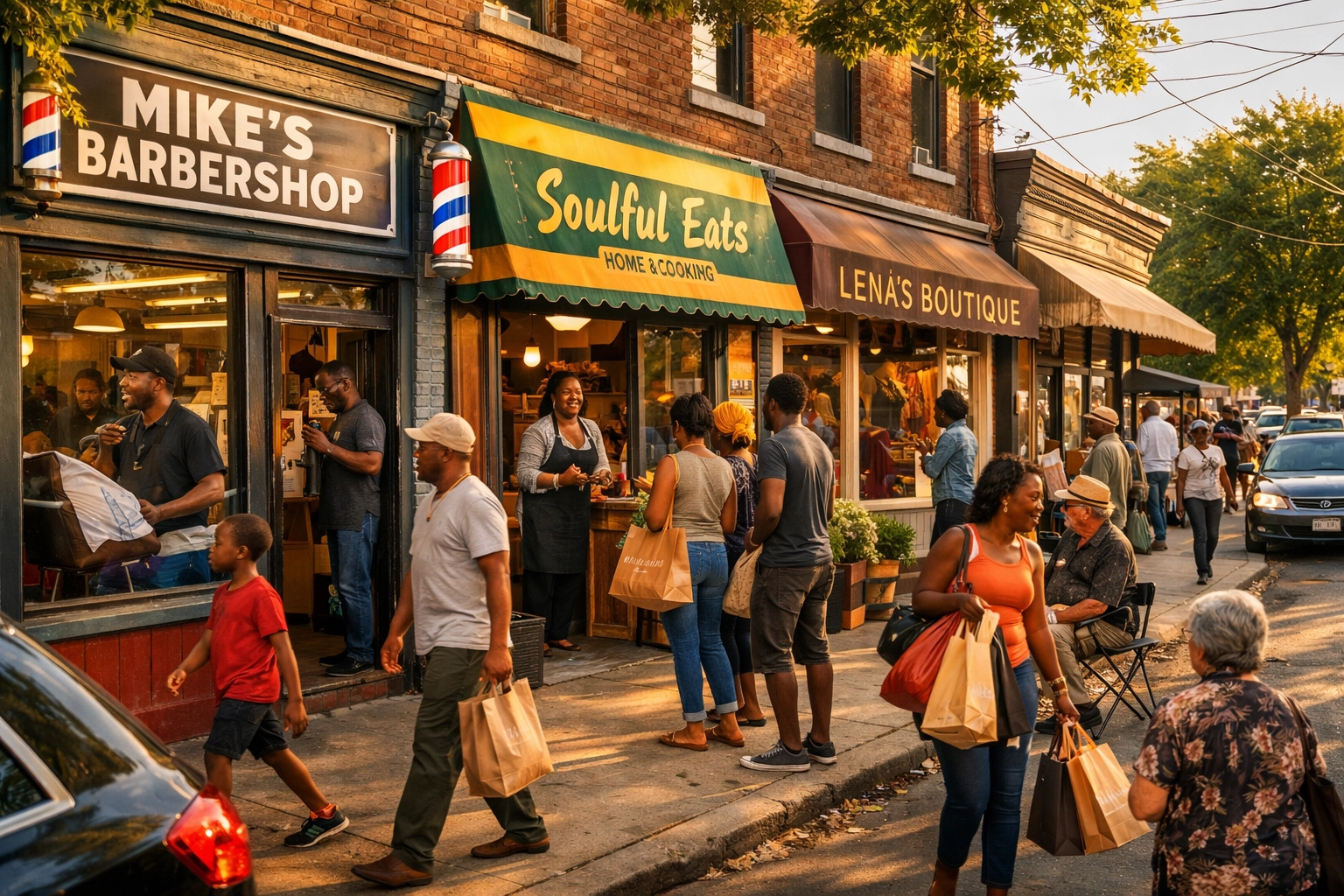
Economists measure this with something called the "multiplier." If the local economic multiplier effect in your area is 1.5, it means every dollar spent locally generates $1.50 in total economic activity. A big-box chain? Their multiplier hovers around 1.0 to 1.2 because most of that money immediately leaves town: heading to corporate headquarters, offshore suppliers, and distant shareholders.
The Simple Math That Changes Everything
Let's walk through a real example. Say your church decides to spend $10,000 on a new sound system. You've got two options:
Option A: Buy from a big online retailer. That $10,000 goes to a warehouse in another state, and maybe $1,000 trickles back to your community through local delivery wages.
Option B: Buy from Jerome's Audio & Video, a Black-owned electronics shop three blocks away. Jerome takes that $10,000 and immediately starts cycling it through your neighborhood.
Here's how Jerome's $10,000 moves:
Jerome pays himself and his two employees ($4,000 stays local)
He buys inventory from a regional supplier ($2,500 stays regional)
He pays rent to a local property owner ($1,200 stays local)
He contracts with a local electrician for installation ($800 stays local)
He buys lunch for his team at the corner deli ($100 stays local)
That's $8,600 that immediately recirculates in your square mile. But we're not done.
Now Jerome's employee takes her paycheck and buys groceries at the neighborhood market. The market owner pays his suppliers. The electrician hires an apprentice. The deli owner restocks from a local baker. Each transaction keeps the money moving, multiplying the original impact.
By the time the dust settles, that $10,000 spent at Jerome's has generated closer to $15,000 in total economic activity within your community. The same $10,000 spent online? It created maybe $11,000 total, with most of it happening somewhere else.
The Velocity of Money: Speed Matters
Economists have another term that matters here: velocity of money. This measures how fast money moves through an economy. The faster it moves locally, the more value it creates.
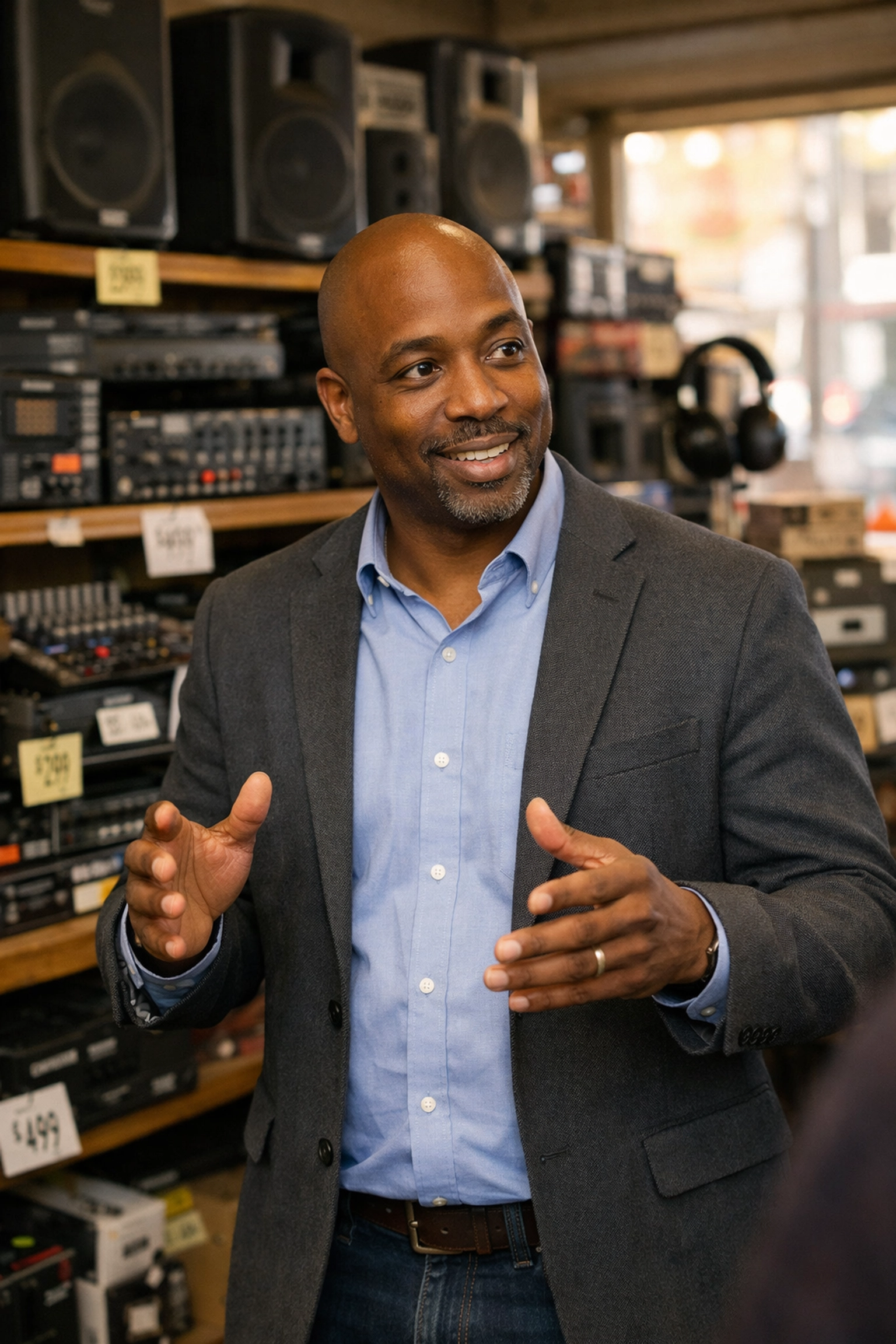
Think of your square mile as a closed system. When money enters and cycles quickly between local businesses, churches, residents, and community organizations, the velocity increases. High velocity equals high impact.
But when that money leaks out: to Amazon, to national chains, to services headquartered in other states: the velocity drops to zero for your community. That dollar is gone. It's now creating velocity somewhere else, probably in a ZIP code that doesn't look anything like yours.
Here's where it gets interesting for churches and faith-based organizations. You're uniquely positioned to increase the velocity of money in your square mile. Your congregation lives there. Your members shop there. Your influence runs deep. When you intentionally direct spending toward local businesses: especially Black-owned businesses that reinvest locally: you're not just making purchases. You're engineering economic transformation.
Why Big-Box Retailers Are Economic Black Holes
Let's be honest about what happens when corporate chains dominate a neighborhood. They're extraction machines.
A national chain pulls profits out of your community at lightning speed. Their business model depends on it. Sure, they hire local workers: usually at minimum wage: but everything else flows upward and outward. The inventory? Purchased from global suppliers. The real estate? Owned by a REIT three states away. The profits? Distributed to shareholders scattered across the country.
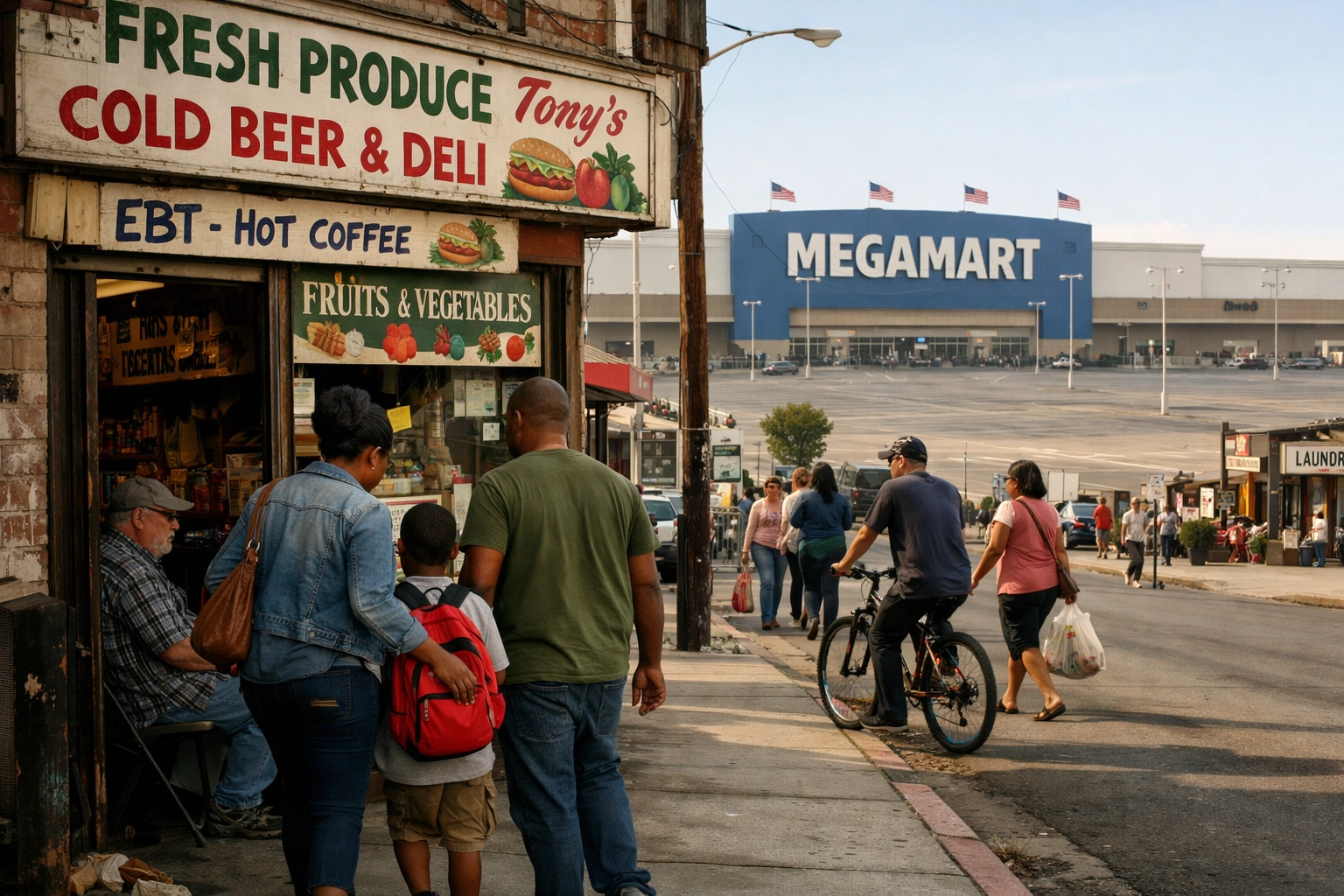
Research shows that for every $100 spent at a locally-owned business, approximately $68 stays in the local economy. That same $100 at a chain store? Only $43 remains local. You're literally watching 57% of your community's wealth evaporate with every transaction.
And here's the part that should make every pastor and community leader pay attention: this isn't just about money. The local economic multiplier effect directly impacts employment, housing stability, educational opportunities, and social cohesion. When wealth circulates locally, communities get stronger. When it extracts, communities hollow out.
Building Closed-Loop Economies in Your Square Mile
This is where the conversation shifts from theory to practice. How do you actually harness the local economic multiplier effect to transform your community?
The answer is deceptively simple: create closed loops.
A closed-loop economy means money enters your square mile and cycles through it multiple times before leaving. This requires three things:
1. Local Production and Services
You need businesses that actually create value locally: restaurants, repair shops, professional services, retailers, contractors. The more diverse your local business ecosystem, the longer money stays in circulation.
2. Local Consumption
Residents and institutions (especially churches) must intentionally choose local vendors. This isn't about charity. It's about understanding that every dollar you spend locally is an investment in your own community's prosperity.
3. Local Reinvestment
Business owners must commit to hiring locally, banking locally, and sourcing from regional suppliers whenever possible. The goal is to keep each dollar cycling as long as possible.

This is exactly what the GSC (Global Square Community) model was built to facilitate. By connecting churches, Black-owned businesses, and community members within defined geographic areas, we're creating the infrastructure for closed-loop economies. The technology simply makes visible what should have been happening all along: neighbors supporting neighbors, institutions investing in their communities, and money multiplying through intentional circulation.
The Faith-Based Economic Development Advantage
Churches have always understood community investment, even if they didn't call it "the local economic multiplier effect." You've been doing potlucks (local food), hiring local contractors for repairs, and organizing community events that support neighborhood vendors.
But imagine scaling that intentionality across every spending decision your church makes. What if you could measure the local economic multiplier effect of your congregation's collective spending power? What if you could see, in real time, how shifting purchases to Black-owned businesses within your square mile creates jobs, stabilizes housing, and builds generational wealth?
That's not a hypothetical. That's the future of faith-based community development.
The Bottom Line
The local economic multiplier effect isn't some abstract academic theory. It's the difference between a neighborhood that thrives and one that survives. It's the reason some communities build wealth while others watch it drain away.
Every dollar is a seed. Where you plant it determines what grows. Plant it in your square mile: in businesses owned by your neighbors, in services provided by your congregation members, in systems designed to circulate rather than extract: and watch it multiply.
The economics are clear. The choice is yours.
Want to see how your church or business can maximize its local economic impact? Learn more about the GSC model and how we're helping communities build closed-loop economies at Our Square Mile.
